Key Takeaways for Aerospace Operations
For aerospace manufacturing and maintenance operations, understanding the fundamentals of surface preparation is non-negotiable. The performance of critical bonds and coatings depends directly on substrate cleanliness and chemistry. Here are the essential points to consider:
- Surface preparation is a foundational step for reliable adhesion. The long-term performance of coatings and bonded joints is determined by the quality of the substrate surface before application.
- Advanced cleaning is a form of contamination control. Its primary goal is the complete removal of oils, oxides, particulates, and other residues that can interfere with wetting and bonding processes.
- Surface energy and chemistry dictate how well coatings and adhesives adhere. Successful adhesion requires precise cleaning and, in some cases, surface activation to create a receptive substrate.
- The selection of a cleaning process must account for the substrate material, component geometry, and specific performance requirements to avoid causing damage or leaving behind harmful residues.
- Adherence to standards from organizations like ASTM International and guidance from bodies like the Federal Aviation Administration (FAA) helps ensure cleanliness, adhesion quality, and process repeatability in critical aerospace applications. [Source: https://www.astm.org/, Source: https://www.faa.gov/aircraft/safety]
The Role of Surface Preparation in Aerospace Adhesion
In aerospace manufacturing, achieving strong and reliable adhesion is not a matter of chance; it is the result of meticulous and scientifically-grounded surface preparation. The performance and durability of coatings, sealants, and adhesive bonds are fundamentally dependent on the cleanliness and chemical state of the substrate. Without an optimally prepared surface, even the most advanced materials can fail to perform as specified.
Poor surface preparation can directly compromise part integrity, which in turn affects overall flight safety. Contaminants create a weak boundary layer that prevents proper bonding, leading to potential delamination or failure under operational stress. Therefore, advanced cleaning is a mandatory prerequisite for any subsequent coating or bonding process. The quality of this preparatory step directly influences the durability and performance of the applied materials, making it a critical control point in the manufacturing workflow.
Understanding Contamination Control in Precision Cleaning
Precision cleaning in an aerospace context extends far beyond simple parts washing. It should be viewed as a systematic process of contamination control, engineered to remove specific soils that can undermine adhesion. The primary objective is to eliminate contaminants such as processing oils, oxides, dust particles, and handling residues that interfere with proper surface wetting and the formation of strong interfacial bonds.
Even microscopic residues can have a significant negative impact on the durability, performance, and ultimate safety of aerospace components. Effective cleaning protocols are therefore designed to remove these specific contaminants without degrading or damaging the underlying substrate material. This ensures that the surface is in an ideal condition for subsequent treatments, such as coating, bonding, or sealing.
Mechanism-to-Outcome Map: Surface Chemistry and Adhesion Performance
The success of any bonding or coating application is governed by surface chemistry and surface energy. Adhesion is an interfacial phenomenon, meaning it is controlled by the chemical and physical interactions at the boundary between the substrate and the applied material, not just by the bulk properties of the materials themselves.
A key concept is surface energy. For a liquid coating or adhesive to bond effectively, it must first be able to wet the surface, meaning it must spread out evenly rather than beading up. Higher surface energy generally supports better wetting. Proper cleaning removes low-energy contaminants like oils, while surface activation techniques can further alter a surface chemically or physically to create a more receptive, high-energy state. This meticulous control over surface chemistry is essential for creating strong, durable interfacial bonds.
Failure Modes and Operational Risks from Inadequate Cleaning
Insufficient or improper cleaning during aerospace manufacturing can introduce significant risks, leading to adhesion failure and a reduced operational lifespan for critical components. Contaminant residues such as oils, oxides, and fine particulate matter act as release agents, creating weak points at the bond line that can compromise the structural integrity of a part.
These weak points can result in common failure modes like delamination, blistering, or a general reduction in coating performance, often leading to expensive rework or part replacement. Beyond the financial cost, uncontrolled contamination poses a direct threat to the operational safety of an aircraft. Failing to properly clean and prepare surfaces before coating or bonding dramatically increases the risk of premature component failure, especially in the demanding and high-stress environments of aerospace operations, a risk that must be managed through disciplined processes and standards.
Advanced Cleaning Approaches for Aerospace Components
The selection of a cleaning process for aerospace components must be a careful and deliberate decision. Factors such as substrate sensitivity, part geometry, type of contamination, and downstream performance requirements all play a role. Using an overly aggressive chemistry or an inappropriate method can damage sensitive materials or leave behind harmful residues that create new problems.
Common approaches include aqueous cleaning systems, which use water-based chemistries, and solvent-based cleaning for specific types of soils. For complex Manufacturing environments, having access to specialized chemistries is important. Practical surface-prep solutions such as New-Clear Blast and Surgical Strike are used as part of maintenance and preparation workflows to address different types of buildup and residue before finishing work.
Regulatory, Safety, and Compliance Considerations
The aerospace industry operates under stringent regulatory oversight, where safety and reliability are paramount. The Federal Aviation Administration (FAA) places a strong emphasis on maintaining material integrity throughout the manufacturing and maintenance lifecycle of an aircraft, as this is fundamental to flight safety. Cleaning and surface preparation are integral parts of this quality assurance framework.
To ensure consistency and quality, standards bodies provide critical guidance. ASTM International develops and publishes technical standards, including test methods and process definitions for verifying surface cleanliness and measuring adhesion. Similarly, ASM International offers deep engineering context for understanding substrate behavior and surface preparation techniques relevant to aerospace materials. Adherence to these established standards is essential for achieving the repeatability, verification, and process control required in high-performance aerospace manufacturing.
A Checklist for Effective Aerospace Surface Preparation
Implementing a robust surface preparation strategy requires a systematic approach. A checklist can help ensure that all critical steps are followed consistently, reducing the risk of process deviations that could compromise adhesion and part quality. Consider the following points in your workflow:
- Identify Contaminants: Accurately identify all potential contaminants specific to your manufacturing process, materials, and environment.
- Select Appropriate Methods: Choose cleaning methods and chemistries that effectively remove the identified contaminants without damaging the substrate or altering its critical properties.
- Verify Cleanliness: Use established and validated test methods, such as those defined by ASTM, to verify that the surface has achieved the required level of cleanliness before applying any coating or adhesive.
- Implement Process Controls: Establish and monitor strict process controls for all cleaning parameters, including time, temperature, concentration, and rinse steps, to ensure repeatable outcomes.
- Consider Surface Energy: Evaluate the surface energy requirements for your specific application to confirm that the prepared surface will support optimal wetting and strong interfacial bonding.
Conclusion: Ensuring Aerospace Reliability Through Precision Cleaning
Advanced cleaning for aerospace components is not a simple janitorial task; it is a critical engineering step that directly contributes to part integrity, long-term performance, and overall flight safety. By mastering surface chemistry through precise and controlled cleaning protocols, manufacturers can support the durable adhesion required for high-performance coatings and structural bonds. This level of contamination control is fundamental to reducing the risk of premature failures in demanding operational conditions.
The investment in proven cleaning and surface preparation solutions is an investment in reliability and safety. By ensuring surfaces are meticulously prepared, manufacturers can reduce the need for costly rework, lower lifecycle costs, and, most importantly, produce components that meet the uncompromising standards of the aerospace industry. Partnering with solution providers that understand the unique demands of aerospace surface preparation is a key step in achieving these goals.
Clean and prep surfaces with CG Chemicals
If you are dealing with buildup, residues, or tough soil before maintenance or finishing work, CG Chemicals offers practical cleaning solutions for high-use environments. Explore New-Clear Blast and Surgical Strike based on your surface and soil type.
Sources
- https://www.chemicalsafetyfacts.org/industrial-cleaning/
- https://www.faa.gov/aircraft/safety
- https://pubs.acs.org/doi/10.1021/acs.langmuir.3c01531
- https://research.birmingham.ac.uk/en/publications/effects-of-structural-and-chemical-properties-of-surface-coatings/
- https://www.astm.org/
- https://www.asminternational.org/
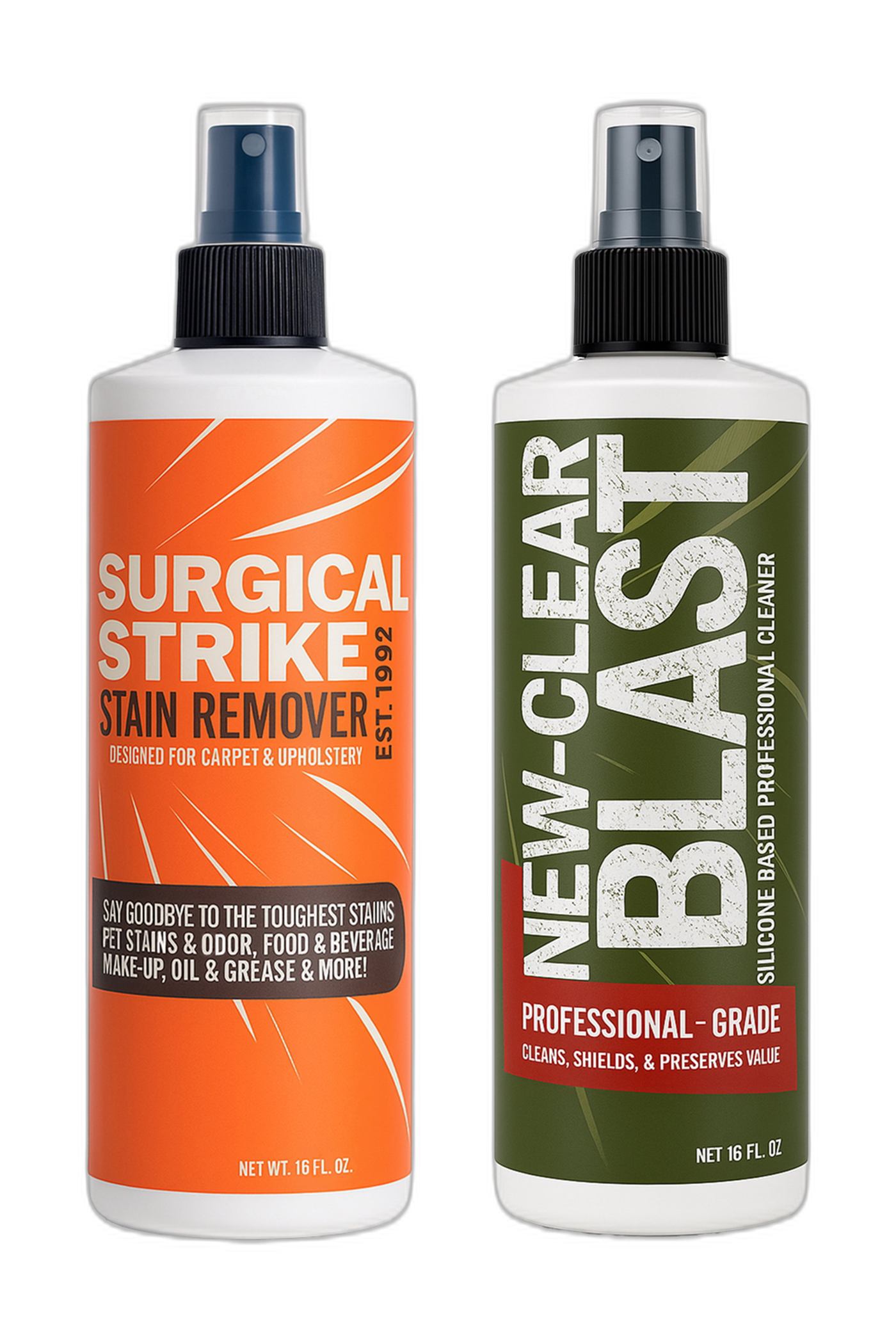
Two formulas. Serious range.
Use Surgical Strike for stains and odor, then New-Clear Blast to clean, shield and preserve hard surfaces.