In precision manufacturing, the integrity of every component is paramount. Achieving the required level of cleanliness is not just a final step; it is a critical process that directly influences performance, reliability, and product lifespan. Selecting the right cleaning method is a technical decision that balances the material of the part, the type of soil, the complexity of the geometry, and the final application's requirements. This guide explores which cleaning methods are best suited to supporting cleanliness in precision manufacturing, helping you make informed decisions for your operations.
Key Takeaways for Precision Cleaning in Manufacturing
Navigating the options for precision parts cleaning requires a clear understanding of the primary methods and their applications. A successful strategy is not one-size-fits-all but is tailored to the specific context of the manufacturing process. Here are the essential points to consider:
- The most effective cleaning method considers the component's geometry, the type of contaminant (soil), and the required cleanliness target.
- Aqueous cleaning offers a robust and scalable approach for many precision parts, effectively removing oils and particulate contamination.
- Ultrasonic cleaning excels for components with intricate geometries, blind holes, and fine features, using cavitation to dislodge contaminants from hard-to-reach areas.
- For heavy oils and greases, solvent and vapor degreasing are relevant methods, particularly where rapid and precise drying is critical.
- A comprehensive precision cleaning process goes beyond the initial wash, incorporating rinsing, drying, and measurable cleanliness verification to ensure standards are met.
The Importance of Method Selection for Component Integrity
Choosing the correct cleaning method is a foundational aspect of quality control in precision manufacturing. An inappropriate method can leave behind residues that lead to component failure or require costly rework. The performance and lifespan of precision parts used in sensitive applications, from aerospace to medical devices, depend on effective contaminant removal.
The ideal cleaning strategy is determined by a careful analysis of the part's characteristics, the nature of the contaminants, and the specified cleanliness level. For instance, a simple, robust part contaminated with light oil may only need a basic aqueous wash. In contrast, a complex component with internal channels and heavy grease will demand a more advanced approach.
Prioritizing production speed at the expense of thoroughness is a common pitfall. While efficiency is important, the primary goal must be part integrity. A properly cleaned component is prepared for subsequent processes like coating, bonding, or assembly, ensuring it functions as designed throughout its operational life.
Aqueous Cleaning for Production Scale Efficiency
Aqueous cleaning systems are a common starting point for many production-scale cleaning operations due to their versatility and effectiveness. These systems use water-based solutions containing detergents, surfactants, or other additives to remove a wide variety of contaminants. For industrial applications, powerful water-based formulas assist with degreasing and soil removal. For example, a cleaner like Surgical Strike is used as part of a process to break down and lift soils such as oils, coolants, and particulate matter from a component's surface.
One of the main advantages of aqueous cleaning is its scalability. These systems can be designed as simple immersion tanks for low-volume work or as complex, multi-stage automated lines for high-volume production. This flexibility makes them suitable for diverse manufacturing environments. The process typically involves a wash stage, one or more rinse stages, and a drying stage to complete the cycle.
This method is particularly effective for removing inorganic particulates and water-soluble oils. The effectiveness of an aqueous process depends on the right combination of chemistry, temperature, agitation, and time. When properly configured, it provides a reliable and repeatable cleaning outcome for many types of precision components.
Ultrasonic Cleaning for Intricate Component Geometries
When components feature complex shapes, blind holes, or intricate internal passages, ultrasonic cleaning becomes a highly effective solution. This method uses high-frequency sound waves transmitted through a liquid cleaning solution. The sound waves create a phenomenon called cavitation, which is the rapid formation and collapse of microscopic bubbles.
The implosion of these tiny bubbles against the component's surface generates a powerful scrubbing action that can dislodge even tightly adhered contaminants. This micro-agitation reaches into crevices and features that are inaccessible to sprays or manual brushing, ensuring a thorough clean across the entire part.
Ultrasonic cleaning is a preferred method for achieving very high levels of cleanliness on small or delicate precision parts without causing surface damage. It can be used with a variety of aqueous cleaning agents to target specific soils. The combination of chemical action from the cleaning solution and the physical action of cavitation provides a powerful cleaning process for the most demanding applications.
Specialized Cleaning: Solvents, Vapor Degreasing, and High-Pressure Spray
For certain types of contaminants, such as heavy oils, greases, waxes, and fluxes, specialized cleaning methods may be necessary. Solvent and vapor degreasing remain effective options in these scenarios, particularly when water-based systems are less suitable or drying is a critical concern. Solvents work by dissolving the soil, which is then removed from the part surface.
Vapor degreasing is a specific solvent-based process where a solvent is boiled to create a vapor. Cooler parts are placed in the vapor, which condenses on their surfaces. This pure, distilled solvent effectively dissolves contaminants, which then drain away with the condensate. The process results in a very clean and dry part.
Mechanical action can also be used to enhance cleaning. High-pressure spray systems use kinetic energy to dislodge soils, while turbulation uses aggressive agitation within a cleaning tank to improve contact between the cleaning solution and the part. These methods are valuable for parts with recessed areas or through-flow channels where directing the cleaning agent is key to success.
Understanding Cleaning Mechanisms: How Contaminants are Removed
Each cleaning method operates on a distinct principle to remove contaminants. Understanding these mechanisms helps in selecting the right process for a specific soil type and part material. The choice often comes down to a combination of chemical and physical forces.
- Aqueous Cleaning: This method relies on the chemical interactions of detergents and surfactants. These agents reduce the surface tension of water, allowing it to wet surfaces more effectively. They work to lift, emulsify (for oils), and suspend particulate soils in the cleaning solution so they can be rinsed away.
- Ultrasonic Cleaning: The primary mechanism here is physical. Cavitation generates microscopic jets and shockwaves that physically dislodge contaminants from the surface, including in very small features. It is a powerful mechanical scrubbing action at a microscopic level.
- Solvent Degreasing: This is a purely chemical process based on solubility. The solvent dissolves organic soils like greases and oils, pulling them away from the part surface into the solution. The contaminated solvent is then drained or rinsed away.
- Mechanical Action: Methods like high-pressure sprays or turbulation use kinetic energy. The force of the fluid hitting the surface shears off and carries away loosened soil particles, complementing the chemical action of the cleaning solution.
Beyond the Wash: Rinsing, Drying, and Cleanliness Verification
A successful precision cleaning process does not end when the wash cycle is complete. The subsequent steps of rinsing, drying, and verification are just as critical for achieving the final cleanliness specification. Improper execution of these stages can re-contaminate an otherwise clean part.
Proper rinsing is crucial for removing any remaining dissolved soils and cleaning agent residues. For many critical applications, demineralized or deionized water is used to prevent the deposition of mineral spots on the part surface. The drying method must also be chosen carefully to prevent recontamination. Common techniques include heating parts to 80-100 C or using filtered dry nitrogen to displace moisture without leaving residue.
Finally, cleanliness must be verified. This involves using measurable contamination limits and repeatable inspection methods to confirm that parts meet the required standard. Standards like ECSS-Q-70-01A define specific levels of molecular and particulate contamination allowable for space hardware, for example. This verification step provides the objective evidence that the entire process, from washing to drying, has been effective.
Mitigating Risks: The Impact of Inadequate Cleaning and Compliance
Inadequate cleaning introduces significant risks in precision manufacturing, potentially leading to part failure, reduced performance, or the need for expensive rework. Contamination control is guided by established standards that define cleanliness levels for critical hardware and applications. For example, MIL-STD-1246C provides a framework for defining the level of particulate and non-volatile residue contamination on surfaces.
Similarly, standards from organizations like the European Cooperation for Space Standardization (ECSS) set stringent requirements for hardware used in space missions. In a broader context, ISO 14644 standards provide guidelines for cleanrooms and controlled environments, addressing airborne particles, chemical contamination, and surface cleanliness assessment. These standards directly impact the environments where precision parts are manufactured, cleaned, and assembled.
Adherence to these or equivalent internal standards is not just about compliance; it is a fundamental practice for mitigating operational risks. By controlling surface impurities, manufacturers can help ensure consistent component quality and reliability, which is essential for any high-stakes application.
Precision Cleaning Method Selection Checklist
To determine the best cleaning method for your precision components, work through a systematic evaluation of your specific needs. This checklist covers the key factors that should guide your decision-making process, ensuring a comprehensive assessment before investing in a cleaning system.
- Assess part geometry: Is the component simple with flat surfaces, or is it intricate with blind holes and internal passages that could trap contaminants and cleaning fluids?
- Identify soil type and adhesion: What are you trying to remove? Are you dealing with light oils, heavy greases, particulate matter, fingerprints, or other residues from the manufacturing process?
- Determine required cleanliness level: What is the final destination of the part? Does it need to meet a specific industry standard or a customer-defined limit for particle counts or chemical residue?
- Consider material compatibility: You must ensure that the cleaning chemistry and the process itself (e.g., temperature, pressure) will not damage or alter the component's material or surface finish.
- Evaluate production volume and speed: How many parts do you need to clean per hour or day? Can the chosen method scale efficiently to meet your manufacturing needs without creating a bottleneck?
Once you have assessed these factors, you can select an appropriate cleaning agent. For instance, removing heavy greases and oils from the manufacturing process often requires a robust degreaser like Surgical Strike. For less intensive cleaning or preparing for final assembly, a multi-surface cleaner like New-Clear Blast can be used to handle lighter soils and residues. Remember to follow all label directions and safety guidelines, such as ensuring adequate ventilation, when working with cleaning chemicals.
By carefully considering these factors, you can select from a wide range of cleaning solutions and methods to build a process that is both effective and efficient.
Sources
- https://www.hoggeprecision.com/what-you-need-to-know-about-cleaning-precision-machined-parts/
- https://www.gemsons.com/post-machining-cleaning-processes-for-precision-components/
- https://indico.cern.ch/event/565314/contributions/2285815/attachments/1473772/2282702/CAS-MT.pdf
- https://www.pfonline.com/articles/precision-cleaning-and-verification-a-practical-guide
- http://esmat.esa.int/ecss-q-70-01a.pdf
- https://snebulos.mit.edu/projects/reference/MIL-STD/MIL-STD-1246C.pdf
- https://www.icccs.net/icccs-technical-committee-itc/iso-standards-14
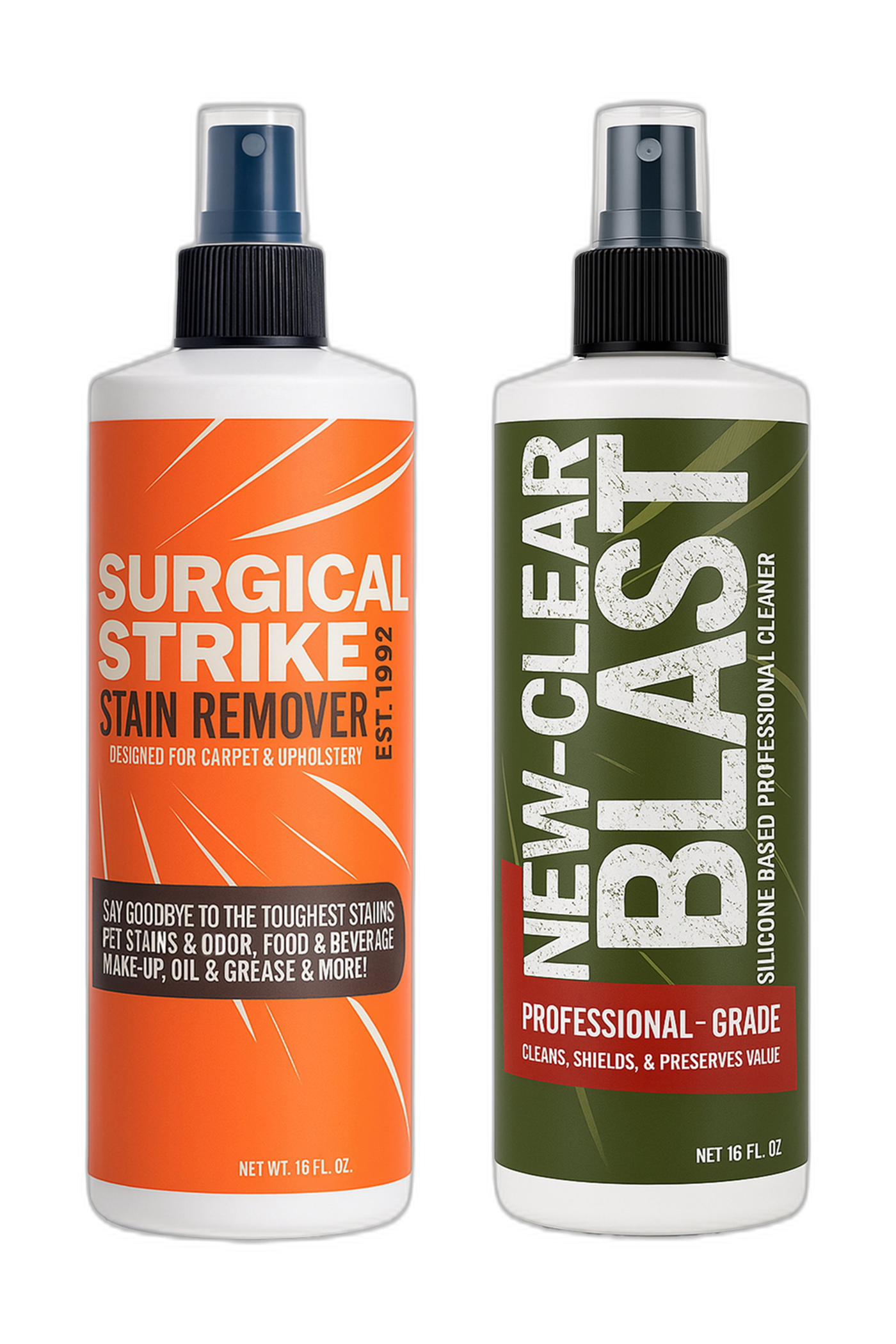
Two formulas. Serious range.
Use Surgical Strike for stains and odor, then New-Clear Blast to clean, shield and preserve hard surfaces.