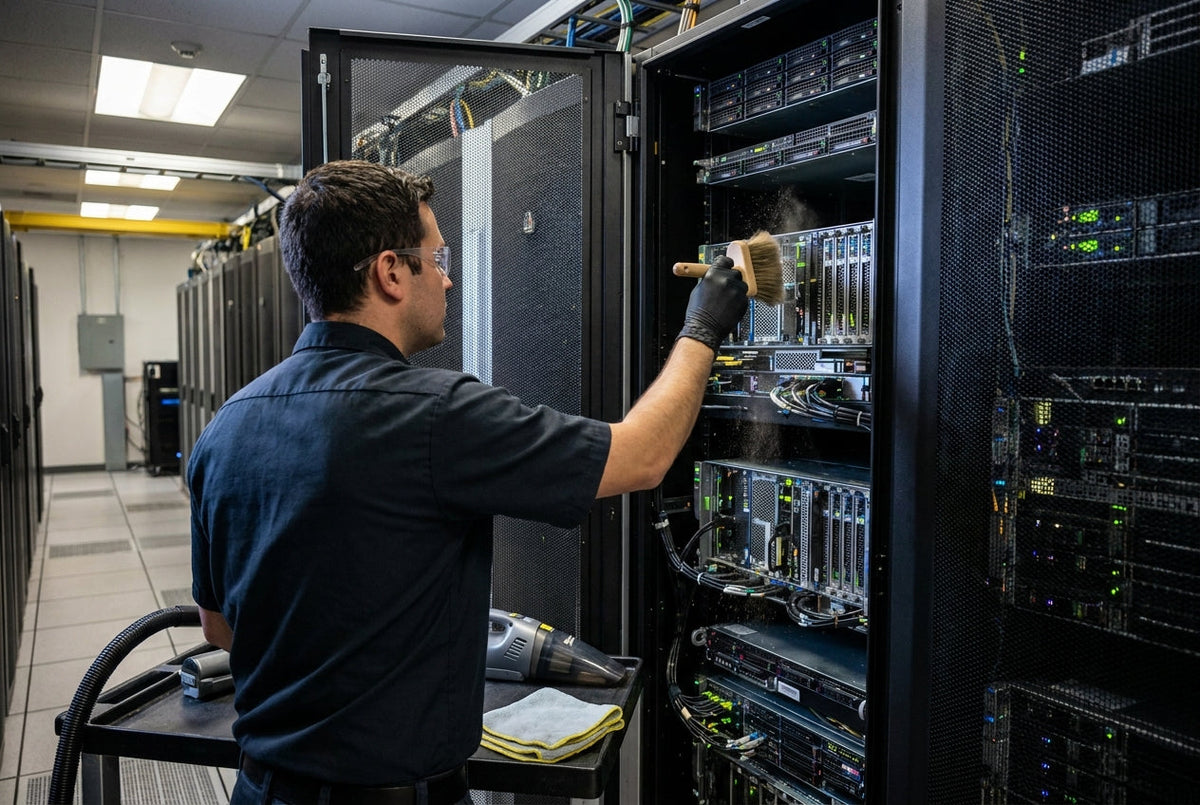
In the controlled environment of a data center, maintaining operational continuity is paramount. While general facility cleaning addresses floors and common areas, a more specialized approach is required for the heart of the operation: the server racks and cabinets. Precision cleaning inside data center racks is a critical maintenance task focused on optimizing airflow to support equipment cooling and operational stability. This is distinct from standard janitorial services, demanding specialized protocols, tools, and chemistries to protect sensitive IT infrastructure.
Key Takeaways: Precision in Data Center Rack Cleaning
Data center rack maintenance requires a detailed understanding of the relationship between cleanliness and thermal management. Unlike general cleaning, the primary goal is to remove obstructions that impede airflow, which is critical for equipment function. The following points summarize the essential considerations for this specialized task.
- Data center rack cleaning is a precision task that focuses on airflow optimization and is separate from general janitorial work.
- Particulate buildup on rack grilles, fan inlets, and cable paths directly obstructs airflow, which can lead to heat accumulation and put stress on equipment.
- Effective cleaning requires the use of ESD-safe tools, anti-static materials, and HEPA- or ULPA-filtered vacuum equipment to prevent damage to sensitive components.
- The use of non-residue, anti-static cleaning solutions is important for compatible cabinet surfaces. Direct wet cleaning of energized electronics should be avoided.
- Adherence to guidelines, such as those from ASHRAE, for environmental control and cleanliness supports data center reliability and performance.
The Critical Role of Airflow in Data Center Racks
Unobstructed airflow within server racks and cabinets is fundamental to maintaining the optimal operating temperatures for critical IT hardware. Data center cooling systems are designed with specific airflow patterns, such as hot-aisle/cold-aisle containment, to efficiently dissipate heat. Any interference with these patterns can compromise the entire cooling strategy.
Dust and particulate accumulation on rack surfaces, perforated doors, fan inlets, and within cable management pathways can significantly disrupt these intended airflow patterns. Even a thin layer of dust can act as an insulator, trapping heat and reducing the effectiveness of heat sinks and cooling fans. This forces cooling systems to work harder, consuming more energy and increasing operational costs.
When airflow is reduced, localized temperatures around components can rise, creating hot spots that stress processors, memory, and power supplies. This elevated thermal stress can shorten the lifespan of equipment and lead to performance throttling or premature failure. Proper airflow management, supported by regular and precise rack cleaning, is directly linked to the operational efficiency and reliability of the data center.
Understanding Contamination: Dust, Particulates, and Corrosion
Contamination in a data center goes beyond visible dust. Airborne particulates can act as an insulating blanket, trapping heat and impeding the heat dissipation capabilities of IT equipment. This forces server fans to spin faster, which consumes more energy and can contribute to higher ambient noise levels. The composition of this dust, which can include fibers, metallic particles, and organic matter, also presents other risks.
Beyond thermal issues, these particulates, when combined with humidity, can create corrosive conditions on sensitive electronic components like circuit boards and connectors. To mitigate this, ASHRAE provides specific guidance on acceptable corrosion rates to help maintain data center reliability. For example, guidance suggests corrosion rates of less than 300 Ångströms per month for copper and less than 200 Ångströms per month for silver are targets for a controlled environment.
Dust accumulation can also interfere with the mechanical operation of server fans, requiring them to use more energy to maintain necessary airflow. Furthermore, certain types of particulate matter can increase the risk of electrostatic discharge (ESD), which can cause catastrophic damage to microelectronics. A comprehensive cleaning strategy addresses these multifaceted risks.
Essential Protocols for Anti-Static Rack Cleaning
To protect sensitive electronic components, all rack and cabinet cleaning procedures must incorporate electrostatic discharge (ESD) control practices. This begins with establishing a properly grounded environment and using personnel who are equipped with ESD wrist straps and appropriate footwear. The goal is to prevent the generation and transfer of static electricity that could damage equipment.
Specialized tools are a cornerstone of data center cleaning protocols. This includes using HEPA (High-Efficiency Particulate Air) or ULPA (Ultra-Low Particulate Air) filtered vacuums. These vacuums are designed to capture microscopic particles without reintroducing them into the environment, which is a significant risk with standard commercial vacuums. Their construction is also designed to be static-dissipative.
For wiping surfaces, anti-static, low-lint wipes are essential. These materials are engineered to minimize the generation of static charges and prevent particle shedding, which could introduce new contaminants into the environment. The primary method for cleaning near electronics should be a controlled dry cleaning approach. Wet cleaning should be limited only to compatible, non-energized surfaces and performed with compatible chemistry and established protocols.
Selecting Compatible Cleaning Chemistry and Tools
The choice of cleaning chemistry for data center environments is critical. Solutions must be non-residue, non-ammoniated, and formulated with anti-static properties to be suitable for use around sensitive equipment. The wrong chemistry can leave behind conductive or corrosive films, attract more dust, or damage surfaces. These types of solutions are appropriate for external cabinet surfaces, rack frames, and other compatible hardware surfaces when applied correctly with anti-static, low-lint cloths. For general maintenance in data center Facilities, a product like New-Clear Blast can serve as a multi-surface cleaner and protector for designated non-critical areas.
It is imperative to avoid the direct application of any liquid or spray onto servers, power distribution units (PDUs), uninterruptible power supplies (UPSs), displays, or any other energized electronics. Wet cleaning should only be performed if explicitly permitted by the original equipment manufacturer (OEM) and according to their exact specifications. Technicians should apply the cleaning solution to the cloth first, away from the equipment, before wiping a surface.
The right tools are just as important as the chemistry. Alongside HEPA or ULPA filtered vacuums, a toolkit should include a variety of static-dissipative brushes and low-lint wipes. These tools help maintain the environmental integrity of the data center and support the safety of the components being serviced.
Targeting Key Rack Components for Airflow Optimization
A comprehensive data center rack cleaning plan must target specific areas where dust accumulation is most likely to obstruct airflow. The plan should cover both the internal and external surfaces of cabinets, with a strategic focus on components directly involved in thermal management.
Perforated doors, grilles, and accessible cable management zones are primary collection points for dust and debris. These perforations are designed to allow air to move freely, and when they become clogged, the efficiency of the entire cooling system can be affected. Similarly, bundles of cables can trap dust, creating blockages that alter air pressure and redirect airflow away from where it is needed most.
Server fan inlets and power supply inlets require careful inspection and cleaning, as any obstruction directly impairs the equipment's ability to cool itself. The cleaning plan should extend beyond the sub-floor to address contamination at the rack level. This includes cleaning rack floors or shelves, as well as the exterior casings of PDUs and UPSs, to remove dust that could become airborne and recirculated.
Regulatory and Environmental Guidelines for Data Center Cleanliness
ASHRAE (American Society of Heating, Refrigerating and Air-Conditioning Engineers) provides authoritative technical standards for data center environmental control. These guidelines include detailed recommendations for managing particulate and gaseous contamination to support equipment reliability and longevity. Following these standards is a best practice for data center operators.
The ASHRAE guidelines often reference ISO 14644-1 for airborne particulate cleanliness, with ISO Class 8 typically cited as a target for the operational data center environment. This standard specifies the maximum allowable concentration of particles of a given size per cubic meter of air, emphasizing the critical importance of particle control. Achieving and maintaining this level of cleanliness requires a holistic approach, including proper filtration, contamination control protocols, and regular, specialized cleaning.
Humidity also plays a key role in contamination control. ASHRAE recommends maintaining relative humidity below 60% because higher humidity levels can cause dust particles to become tacky and adhere more strongly to surfaces. It can also accelerate the corrosive effects of certain gaseous contaminants. Effective cleanliness management is a critical component of overall environmental control, working alongside proper HVAC system maintenance, air filtration, and leak prevention to create a stable operating environment.
Developing a Proactive Rack Cleaning Schedule
A one-size-fits-all cleaning schedule is not effective for server cabinets and racks. The optimal frequency for cleaning should be determined by site-specific conditions and a risk-based assessment. Factors that influence this schedule include the efficiency of the data center's air filtration systems, the level of foot traffic and personnel activity, and any nearby construction or maintenance work that could introduce contaminants.
Establishing a baseline plan, such as quarterly or semi-annual cleaning for server cabinets, provides a starting point for maintenance operations. This can be adjusted based on regular visual inspections and environmental monitoring data. If inspections reveal rapid dust accumulation, the frequency should be increased. This proactive approach helps manage contamination before it can impact equipment performance. For a full list of environments where cleaning solutions are used, see our Applications list.
A successful cleaning program is supported by thorough documentation. Recording when each rack was cleaned, the procedures performed, and any observations made helps track maintenance history and identify trends. This, combined with regular checks of HVAC filters and other environmental control systems, forms a comprehensive strategy for managing data center cleanliness and supporting long-term reliability.
Data Center Rack Cleaning Checklist
A systematic approach to data center rack cleaning ensures that all critical steps are completed effectively. The following checklist provides a general framework that should be adapted to specific site requirements and OEM guidelines.
- Pre-Cleaning Preparation: Conduct pre-cleaning change control notifications and review the criticality of the equipment. Consult any OEM restrictions or specific cleaning instructions for the hardware involved.
- Verify ESD Controls: Ensure all ESD controls are in place and functioning correctly. This includes testing personnel grounding straps and confirming that all cleaning equipment is rated for ESD-safe use.
- Dry Soil Removal: Begin with dry soil removal using a HEPA- or ULPA-filtered, ESD-safe vacuum. Carefully vacuum rack exteriors, accessible interior surfaces, and surrounding floor areas to capture loose particulates without dispersing them.
- Surface Wiping: For external cabinet panels, perforated doors, and other compatible hard surfaces, use low-lint, anti-static wipes lightly dampened with a compatible, non-residue cleaning solution. Never spray liquids directly onto or near equipment.
- Target Airflow Paths: Pay special attention to inspecting and cleaning perforated doors, grilles, fan inlets, and accessible cable management zones. The primary objective is to ensure these pathways are clear and can support unobstructed airflow.

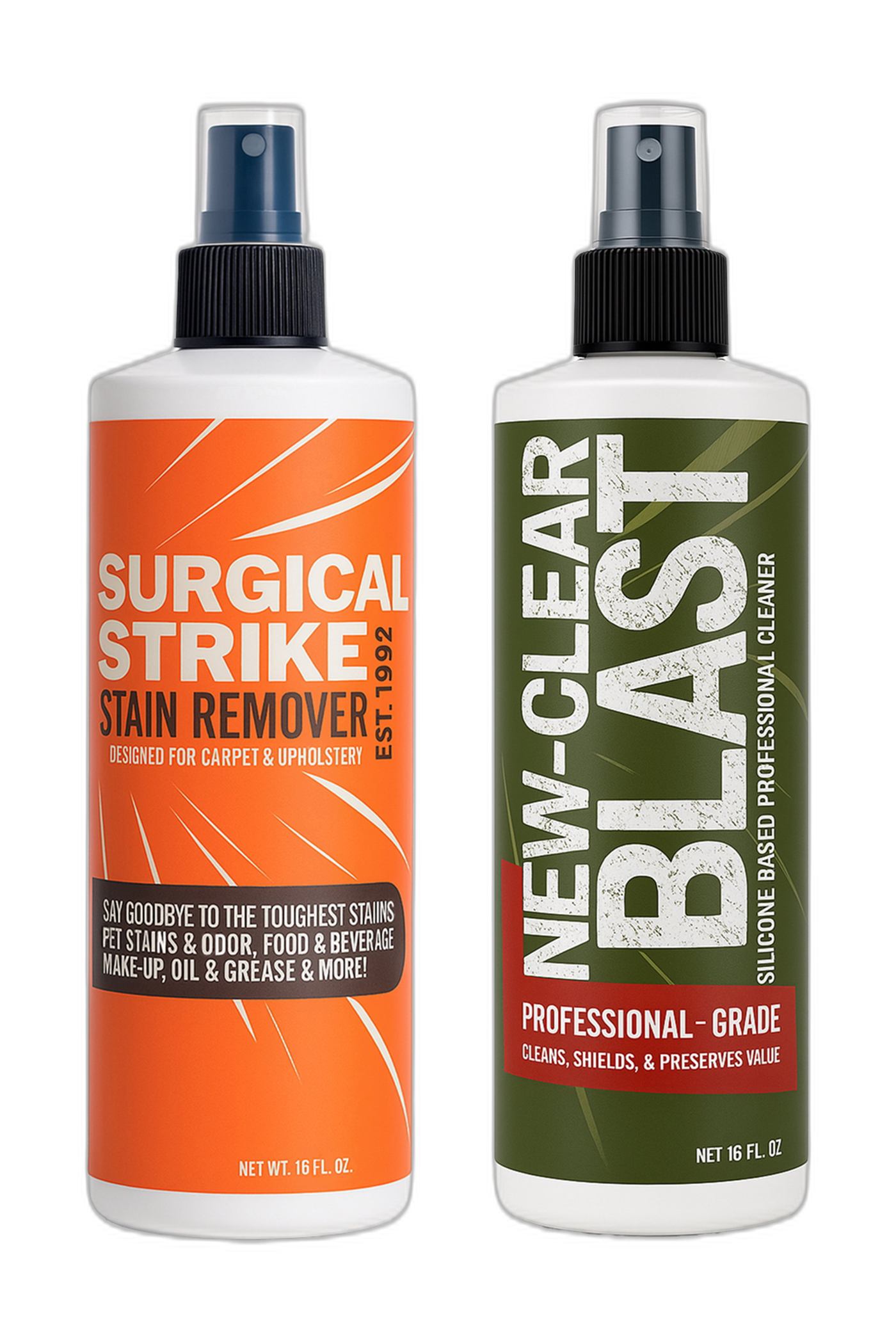
Two formulas. Serious range.
Use Surgical Strike for stains and odor, then New-Clear Blast to clean, shield and preserve hard surfaces.