The performance and longevity of automotive components depend heavily on the quality of their surface treatment. From preventing corrosion to ensuring proper adhesion of coatings, the initial cleaning and preparation phase is a critical step in the manufacturing and maintenance lifecycle. This article explores essential automotive surface treatment cleaning solutions, outlining the methods, risks, and benefits associated with achieving component integrity.
Key Takeaways
- Alkaline cleaning, using 1-5% NaOH at 40-60°C for 5-15 minutes, effectively removes oils and organic residues from automotive parts.
- Plasma treatment activates surfaces by breaking molecular bonds, a process which can support coating adhesion without damaging base materials.
- Vapor degreasing employs solvent vapor to dissolve contaminants, and integrating solvent recovery systems can help reduce operational costs in industrial cleaning.
- Acid pickling, typically with 5-15% HCl or H2SO4 at 20-30°C for 5-10 minutes, removes rust and scale but requires subsequent neutralization to prevent corrosion.
- Adhering to EPA guidelines for industrial cleaning products is essential for minimizing environmental impact and ensuring worker safety through responsible chemical use.
Failure Modes or Operational Risks in Automotive Surface Treatment
Improper surface preparation can lead to significant operational failures and increased costs. Residual contamination, such as oils, grease, or particulate matter on automotive components, can directly impede the adhesion of subsequent coatings or finishes. This leads to delamination, blistering, or other defects that compromise the part's performance and shorten its service life.
Incomplete or incorrect cleaning processes can also introduce new risks. For instance, acid pickling is effective for rust removal, but if the surface is not properly neutralized afterward, it can lead to localized corrosion that degrades the component's structural integrity. Similarly, using harsh or incompatible cleaning agents can degrade the material properties of the part itself, potentially causing premature failure. These issues often result in the need for rework or complete component replacement, which increases costs and reduces efficiency in both manufacturing and fleet maintenance operations.
Mechanism-to-Outcome Map: Precision Cleaning for Performance
Understanding the mechanisms behind various cleaning methods helps clarify how they contribute to successful surface treatment. For example, alkaline degreasing works through a chemical process called saponification, which converts fats and oils into soap, allowing them to be easily washed away. This process emulsifies organic residues, leaving a clean substrate that is ready for subsequent treatments.
Other methods operate on different principles. Acid pickling chemically dissolves inorganic contaminants like rust and scale, exposing the bare metal. Plasma treatment uses energetic species to break molecular bonds on a component's surface, which increases its surface energy and enhances wettability for better coating adhesion. Modern cleaning solutions often utilize novel surfactant chemistries to achieve targeted cleaning at a molecular level, removing specific contaminants without requiring aggressive mechanical action. The ultimate goal of these mechanisms is to control surface tension and energy, preparing a surface that is optimal for painting, bonding, or other finishing processes.
Essential Cleaning Methods for Automotive Components
Several established methods are used to prepare automotive components in Manufacturing environments. The selection depends on the material, the type of soil, and the desired outcome.
- Alkaline Cleaning: These solutions are highly effective for degreasing and removing organic films from metal surfaces. A typical application involves a 1-5% concentration of NaOH at 40-60°C for 5 to 15 minutes.
- Acid Pickling: Used primarily to remove inorganic scale and rust, this method typically uses hydrochloric or sulfuric acid. Proper neutralization and rinsing are critical steps following this process.
- Vapor Degreasing: This method uses condensed solvent vapor to wash away contaminants. It is a well-established industrial process for cleaning metal parts before finishing.
- Ultrasonic and Immersion Cleaning: Ultrasonic cleaning uses high-frequency sound waves to agitate a cleaning solution, dislodging stubborn contaminants from complex surfaces. Immersion cleaning involves soaking parts in a tank of cleaning fluid, which is suitable for components with intricate geometries or heavy soil loads.
Advanced Surface Activation Techniques
Beyond initial cleaning, advanced surface activation techniques are sometimes employed to prepare a surface for bonding or coating. These methods modify the outermost layer of a material to make it more receptive to adhesion. Plasma treatment, for example, uses ionized gas to break molecular bonds on the surface and introduce new functional groups. This process increases surface reactivity and energy, which assists with the performance of paints and coatings.
Corona treatments function similarly, using an electrical discharge to enhance surface energy and wettability. Both plasma and corona treatments can be integrated into production lines to create a uniform and consistent surface preparation. By ensuring strong chemical bonding between the substrate and the subsequent layer, these techniques support long-term coating durability and overall component integrity.
Economical and Environmental Benefits of Modern Cleaning
Modernizing cleaning processes offers significant economic and environmental advantages. For instance, in vapor degreasing operations, integrating solvent recovery systems can capture and reuse cleaning agents. This practice helps lower the operational costs associated with solvent purchase and disposal.
Switching to alternative methods can also provide benefits. Water blasting is an option for surface preparation that reduces the dust generation associated with traditional abrasive methods. From a compliance standpoint, utilizing cleaners that align with EPA guidelines helps reduce environmental impact and assists with regulatory adherence. By optimizing processes to reduce water usage and waste, automotive manufacturers can use resources more efficiently while promoting environmental responsibility.
Regulatory, Safety, or Compliance Considerations
Navigating the regulatory landscape is a key part of industrial cleaning operations. Adherence to EPA guidelines on industrial cleaning products is critical for ensuring that chemical usage minimizes environmental harm. This includes responsible selection of cleaning agents and proper management of waste streams.
Worker safety is another paramount concern. Handling industrial cleaners requires strict safety protocols, including the use of personal protective equipment (PPE) and ensuring adequate ventilation to prevent exposure. Furthermore, certain processes carry inherent safety requirements. For example, the neutralization step after acid cleaning is not just for performance; it is also a safety measure to prevent ongoing corrosive action that could compromise component stability. Following these compliance and safety standards helps reduce liability and supports a safe working environment for personnel.
Selection Checklist: Choosing the Right Cleaning Solution
Selecting the most appropriate automotive surface treatment cleaning solution requires a systematic approach. A careful evaluation of several factors will lead to an effective and efficient process.
- Identify Contamination: The first step is to identify the specific type and amount of soil on the component. Whether it is oil, grease, rust, scale, or other residues will determine the necessary cleaning chemistry.
- Consider Material Compatibility: The cleaning solution must be compatible with the component's base material to prevent damage, such as etching or hydrogen embrittlement.
- Evaluate Process Requirements: Consider the desired surface finish and the needs of subsequent processes like coating or bonding. Some applications may require a specific surface energy or texture that the cleaning process must help achieve.
- Assess Environmental and Regulatory Factors: Choose solutions that align with environmental policies and EPA guidelines. This includes considering factors like VOC content, biodegradability, and waste disposal requirements.
For tough degreasing and stain removal needs, a product like Surgical Strike may be suitable as part of the overall cleaning protocol.
Clean and prep surfaces with CG Chemicals
If you are dealing with buildup, residues, or tough soil before maintenance or finishing work, CG Chemicals offers practical cleaning solutions for high-use environments. Explore New-Clear Blast and Surgical Strike based on your surface and soil type.
Use with adequate ventilation. Avoid contact with eyes and prolonged skin contact. Keep out of reach of children. Follow label directions.
Sources
- https://hlh-js.com/resource/blog/surface-cleaning-solutions-effective-industrial-methods/
- https://www.brighton-science.com/blog/a-summary-of-surface-treatment-methods-for-manufacturers
- https://www.laytontechnologies.com/Solvents%20-%20Current%20Guidance/Surface%20cleaning%20-%20choosing%20the%20best%20option.pdf
- https://www.epa.gov/chemical-research/research-and-guidance-industrial-cleaning-products
- https://www.sae.org/publications/technical-papers
- https://cen.acs.org/content/cen/articles/99/i33/Surface-chemistry-smart-cleaning.html
- https://www.ellsworth.com/resources/surface-preparation-guide/
- https://rjforbespainting.com/surface-preparation-methods-for-businesses/
- https://hlh-js.com/resource/blog/surface-cleaning-solutions-effective-industrial_methods/
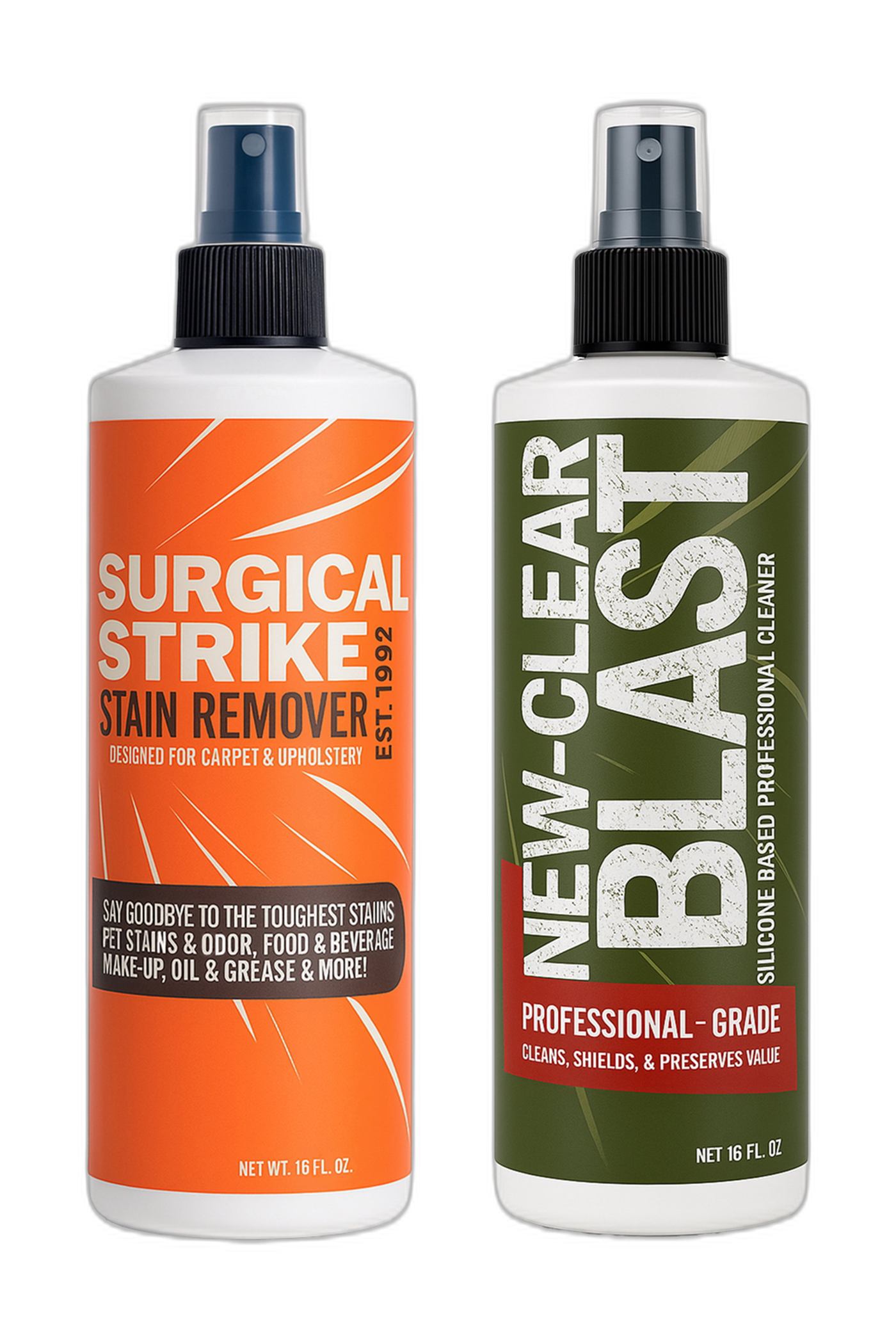
Two formulas. Serious range.
Use Surgical Strike for stains and odor, then New-Clear Blast to clean, shield and preserve hard surfaces.