Aerospace composite materials require exacting surface preparation to support reliable adhesion for coatings, bonding, and repairs. Inadequate cleaning can introduce contaminants that compromise the structural integrity and operational performance of critical components. The unique properties of composites demand specialized approaches that remove foreign matter without damaging the sensitive substrate.
Failure to achieve a properly prepared surface can lead to delamination, coating failure, and other defects that pose significant risks in high-performance environments. As the aerospace industry continues to innovate with advanced materials, the techniques for cleaning and preparing them must also evolve. This article details modern cleaning processes and specialized chemistries essential for modern aerospace Manufacturing and maintenance operations, ensuring components meet stringent quality and safety standards.
Key Takeaways for Aerospace Surface Cleaning
For industrial decision-makers and technicians, understanding the available cleaning methods is crucial for process optimization and quality control. The primary methods and their functions include:
- Wiping composite surfaces with approved solvents like Methyl Ethyl Ketone (MEK) or Isopropyl Alcohol (IPA) on lint-free cloths is a standard procedure for removing contaminants without causing damage.
- Plasma cleaning is an advanced technique that effectively removes organic and inorganic contaminants, which helps prepare the surface for subsequent coatings and bonds.
- Laser ablation provides a precise method for removing resins and other residues from composite molds, helping to extend tool life while protecting the underlying substrate.
- Ultrasonic cleaning offers deep penetration into composite structures, reducing the need for harsh chemicals and minimizing environmental impact through a cavitation-based process.
- Specialized solvents, including Acetone and MEK, are selected for their effectiveness in targeting and dissolving specific uncured resins and oils during composite surface preparation.
Traditional Methods: Solvent Wiping for Immediate Contamination Removal
Solvent wiping is a foundational and widely used method for preparing composite surfaces. Technicians use lint-free cloths soaked in solvents such as Methyl Ethyl Ketone (MEK) or Isopropyl Alcohol (IPA) to manually clean components. This process is designed to remove surface-level contaminants like oils from handling, fingerprints, dust, and residues of uncured resins.
The main goal of solvent wiping is to produce a clean, dry surface that is ready for subsequent steps, whether that is a visual inspection, bonding, or the application of a coating. The procedure must be performed carefully to avoid redistributing contaminants or leaving behind solvent residue. It remains a critical first step in many aerospace surface preparation protocols before more advanced treatments are considered.
Advanced Cleaning: Enhancing Adhesion with Plasma Treatment
Plasma treatment is an advanced surface modification technique that effectively removes organic and inorganic contaminants at a microscopic level. The process uses ionized gas to create a chemical reaction on the composite surface, breaking down contaminants and altering the surface energy. This treatment prepares composite fibers and matrices for improved bonding and structural durability.
By activating the surface, plasma cleaning creates a more receptive substrate for adhesives, coatings, and other finishes. It is a dry, solvent-free alternative to some wet-chemical processes, making it particularly suitable for sensitive aerospace components where material integrity is paramount. This technology supports the high-quality surface preparation required for reliable and long-lasting performance in demanding aerospace applications.
Precision Cleaning: Laser Ablation for Mold and Surface Preparation
Laser cleaning, or ablation, offers a high-precision method for removing contaminants from composite materials and manufacturing molds. The process uses focused laser beams to vaporize unwanted residues, such as resins or release agents, without making physical contact with or damaging the substrate. This non-abrasive technique is especially valuable for maintaining the integrity and extending the lifecycle of expensive composite molds.
For preparing Carbon Fiber Reinforced Plastic (CFRP) surfaces for bonding, Nd:YAG lasers have been shown to be effective, in some cases outperforming traditional abrasive methods by creating a clean and textured surface that supports strong mechanical interlocking. Laser cleaning processes can also be automated, which helps minimize operator variability and reduce downtime in production environments.
Deep Cleaning: Ultrasonic Technology for Composite Materials
Ultrasonic cleaning is a powerful method that provides deep, uniform cleaning of composite parts, including those with complex geometries. The technology works by generating high-frequency sound waves in a liquid bath, creating microscopic cavitation bubbles. When these bubbles implode near the part's surface, they generate intense energy that dislodges embedded particles, oils, and other contaminants without causing mechanical damage.
This method helps reduce reliance on harsh or aggressive chemicals and is recognized for its ability to clean intricate structures thoroughly. To ensure material compatibility, specialized aqueous low-foaming detergents are often used. These cleaning agents are formulated to work effectively with aerospace-grade composites and alloys without promoting corrosion, making ultrasonic cleaning a versatile solution for maintenance and manufacturing.
Failure Modes or Operational Risks: The Impact of Inadequate Surface Preparation
The consequences of insufficient surface preparation in aerospace are significant. Poor cleaning directly contributes to weak adhesion of coatings and bonding agents on composite components. Contaminants like residual mold release agents, oils, dust, or uncured resins act as a barrier, preventing proper chemical bonding and leading to premature delamination or coating failure under operational stress.
When adhesion is compromised, the overall structural integrity and durability of an aerospace part can be reduced, posing direct operational risks. Proper surface preparation is critical across many different industrial applications to ensure long-term performance. Furthermore, cleaning conducted before an inspection is vital; if not done correctly, it can mask underlying material defects like microcracks or porosity, potentially allowing a compromised part to enter service.
Mechanism-to-Outcome Map: Cleaning Processes and Their Impact
Understanding the link between a cleaning mechanism and its outcome helps in selecting the right process for a specific task. Each method offers a distinct advantage for surface preparation:
- Solvent Wiping: This process physically dissolves and removes surface-level contaminants like light oils and fingerprints. The primary outcome is a visually clean surface prepared for initial inspection or a subsequent cleaning step.
- Plasma Treatment: Using ionized gas, this method chemically alters and activates the composite surface. The outcome is improved matrix bonding and enhanced adhesion performance for coatings and adhesives.
- Laser Ablation: Precise energy pulses vaporize unwanted residues from the surface. This creates clean micro-patterns that can improve the mechanical interlocking needed for strong bonds.
- Ultrasonic Cavitation: The implosion of microscopic bubbles generates a powerful but non-abrasive scrubbing action. The result is a deep and uniform clean that can penetrate complex geometries.
Regulatory, Safety, and Compliance Considerations in Aerospace Cleaning
Aerospace cleaning processes are governed by stringent standards to ensure safety, quality, and environmental compliance. Organizations like SAE International publish Aerospace Material Specifications (AMS) that provide detailed guidelines for composite surface preparation and cleaning.
Operator safety is a primary concern, especially when using volatile solvents like MEK and IPA. Proper personal protective equipment (PPE), adequate ventilation, and adherence to handling procedures are mandatory to minimize exposure and comply with regulations. When using any chemical solution, always follow label directions. Furthermore, practices such as using reusable canisters for cleaning wipes can help reduce solvent usage and Volatile Organic Compound (VOC) emissions, supporting environmental goals. Strict adherence to specified cleaning protocols is essential for maintaining product quality and meeting industry standards.
Selecting the Right Cleaning Approach: A Checklist for Industrial Decision-Makers
Choosing the appropriate cleaning method requires a systematic evaluation of materials, contaminants, and operational goals. This checklist provides a framework for making an informed decision:
- Evaluate Material Compatibility: Assess the specific composite material type and its sensitivity to chemical agents or mechanical abrasion.
- Identify Contaminants: Determine the nature of the contaminants that need to be removed, such as oils, uncured resins, dust, or other manufacturing residues.
- Define the Desired Outcome: Clarify the objective of the cleaning process. Is the goal visual cleanliness for inspection, enhanced surface energy for adhesion, or preparation for a repair procedure?
- Assess Operational Factors: Consider practical aspects like production volume, potential for automation, cost, and environmental impact goals associated with different methods.
- Ensure Compliance: Verify that the selected methods and materials comply with all relevant aerospace material specifications (AMS) and internal safety protocols.
Clean and prep surfaces with CG Chemicals
If you are dealing with buildup, residues, or tough soil before maintenance or finishing work, CG Chemicals offers practical cleaning solutions for high-use environments. Explore New-Clear Blast for multi-surface cleaning and Surgical Strike for degreasing and stain removal needs based on your surface and soil type. For a comprehensive two-solution approach, consider the Power Pack (Bundle).
Sources
- https://www.sciplasma.com/post/plasma-cleaning-in-aerospace-industry
- https://www.sae.org/standards/content/ams-c-27232a/
- https://sassofia.com/blog/cleaning-procedures-for-preparation-of-aircraft-composite-panels-visual-inspection-and-tap-testing/
- https://www.compositesworld.com/articles/laser-cleaning-in-composites-manufacturing
- https://brioultrasonics.com/en/ultrasonic-cleaning-of-composite-materials-and-advanced-alloys/
- https://www.youtube.com/watch?v=QDLXaT1fQ9c
- https://ntrs.nasa.gov/api/citations/20100021129/downloads/20100021129.pdf
- https://iberkleen.com/en/cleaning-aerospace-and-aeronautics-industry/
- https://www.compositesworld.com/articles/what-to-look-for-in-adhesives-for-composite-bonding
- https://www.compositesworld.com/articles/advanced-cleaning-techniques-for-aerospace-composites-are-evolving
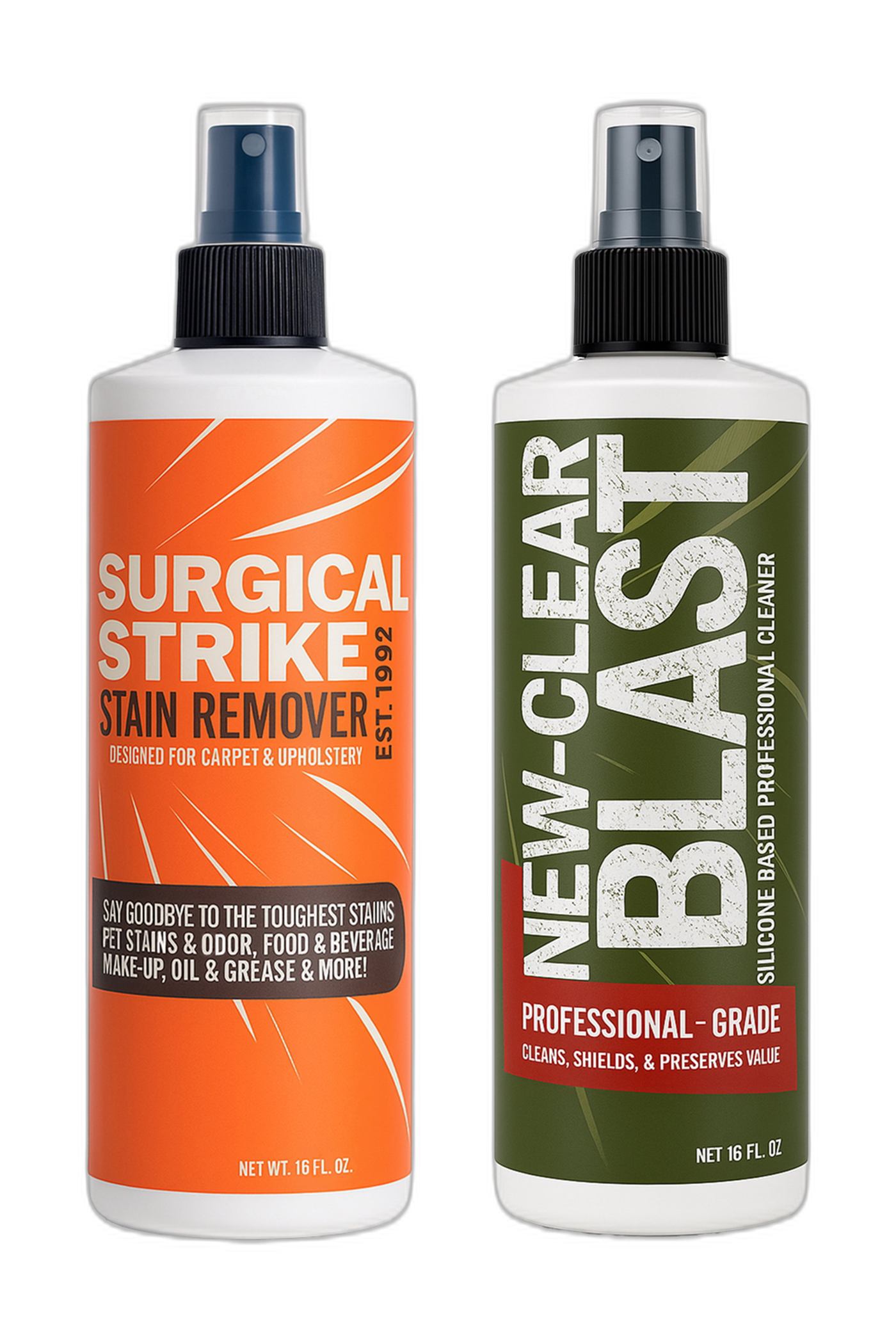
Two formulas. Serious range.
Use Surgical Strike for stains and odor, then New-Clear Blast to clean, shield and preserve hard surfaces.